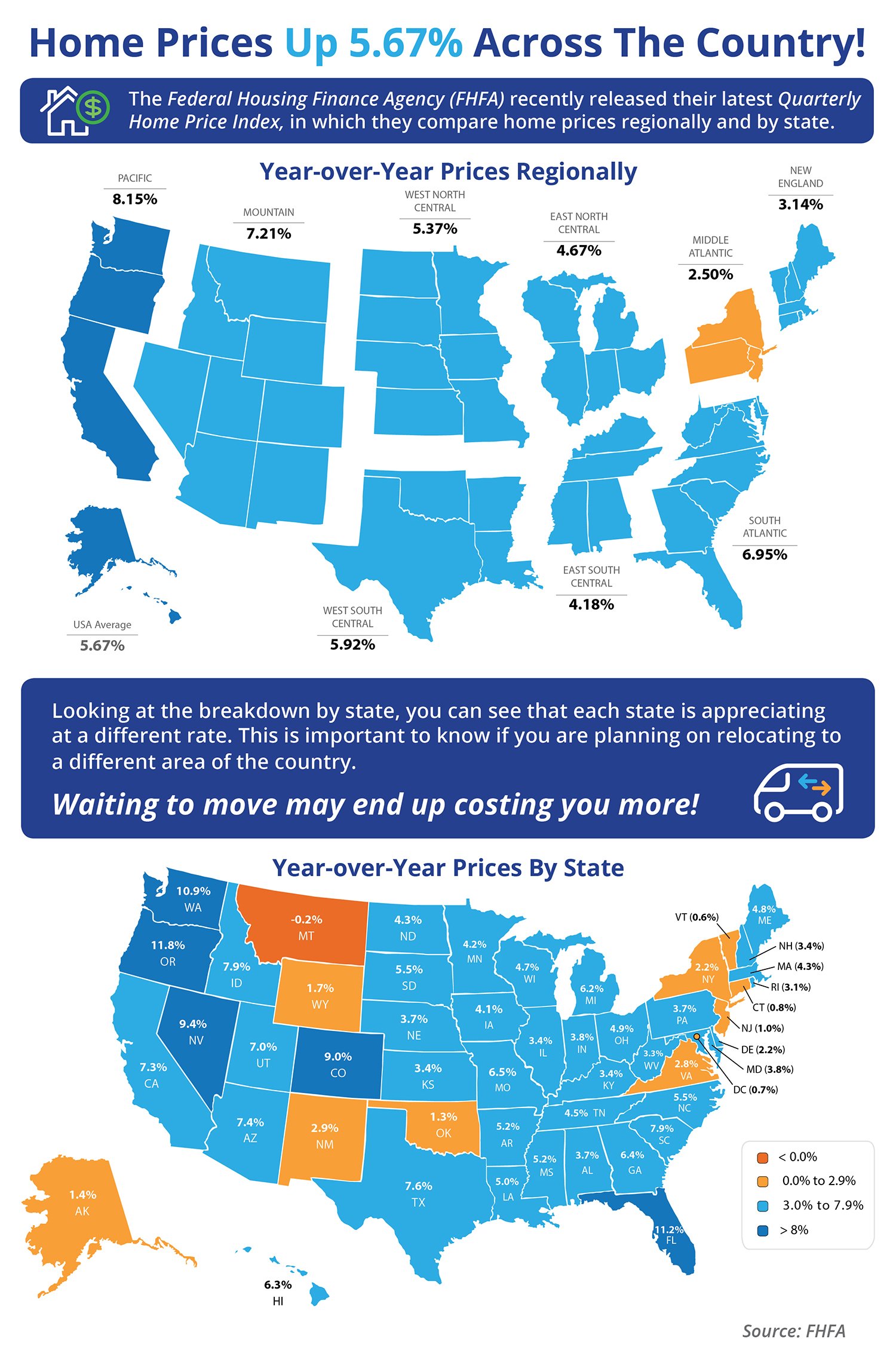
In CoreLogic’s latest Home Price Index, they revealed home appreciation in three categories: percentage appreciation over the last year, over the last month, and projected appreciation over the next twelve months.
This is the 48th consecutive month with year-over-year price gains.
Lawrence Yun, NAR's Chief Economist says that, "The main issue continues to be a supply & affordability problem. Finding the right property at an affordable price is burdening many potential buyers."
Inventory is still below historic norms at a 4.4 month supply.
Two weeks ago, we posted a blog which explained that current increases in home prices were the result of the well-known concept of supply & demand and should not lead to conversations of a new housing bubble. Today, we want to look at home prices as compared to current incomes.
CoreLogic’s latest Equity Report revealed that one million borrowers regained equity in their homes in 2015. The outlook for 2016 remains positive as well, as an additional 850,000 properties would regain equity if home prices rose another 5% this year.
When a homeowner decides to sell their house, they obviously want the best possible price with the least amount of hassles. However, for the vast majority of sellers, the most important result is to actually get the home sold.
As a seller, you will be most concerned about ‘short term price’ – where home values are headed over the next six months. As either a first-time or repeat buyer, you must not be concerned only about price but also about the ‘long term cost’ of the home.
We recently reported that home prices are continuing to rise across most of the nation. This has created concern in some pundits that a housing bubble, like we saw ten years ago, is forming again. We want to explain why these concerns are unfounded.
According to the latest Beracha, Hardin & Johnson Buy vs. Rent (BH&J) Index homeownership is a better way to produce greater wealth, on average, than renting.
There are many young people debating whether they should renew the lease on their apartment or sign a contract to purchase their first home. As we have said before, mortgage interest rates are still near historic lows and rents continue to rise.
Yesterday, we discussed the reasons why homeownership makes sense, financially. Today we wanted to touch on the emotional or ‘real’ reasons that many Americans strive to become homeowners.
Existing Home Sales rose to an annual rate of 5.47 million, representing an 11% increase year-over-year.
Inventory levels remain below the 6-month supply needed for a normal market at a 4.0-month supply.
Lawrence Yun, NAR's Chief Economist, warns: "The spring buying season is right around the corner and current supply levels aren't even close to what's needed to accommodate the subsequent growth in housing demand."
The National Association of Realtors (NAR) released their latest Quarterly Metro Home Price report earlier this month. The report revealed that home prices are not only continuing to rise but that the increases are accelerating. Lawrence Yun, Chief Economist at NAR, discussed the impact of low inventory on buyers in the report:
Just two weeks ago, we posted an article discussing where mortgage interest rates may be heading over the next twelve months. We quoted projections from Fannie Mae, Freddie Mac, the Mortgage Bankers’ Association and the National Association of Realtors. Each predicted that rates would begin to rise slowly and steadily throughout 2016.
With spring right around the corner, you may be wondering if you should wait to enter the housing market. Here are four great reasons to consider buying a home today instead of waiting.
During the recession, many young adults graduating from college were forced to move back in with their parents. This caused new household formations to drop dramatically from the long term average of 1.2 million formations annually to half that number. However, this may be the year this turns back around.
Finally, the issue of homeownership has become a platform talking point in this year’s presidential debate. Yesterday, one of the candidates running for President spoke out about the importance of homeownership in America.
Checkers is a simple game with a simple objective; eliminate the other player’s pieces. Even the process of doing so is simple, jump the other player’s pieces and start a collection. There is very little thought as to a defensive strategy and it is often more reactive than strategic.
Every three years the Federal Reserve conducts a Survey of Consumer Finances in which they collect data across all economic and social groups. The latest survey, which includes data from 2010-2013, reports that a homeowner’s net worth is 36 times greater than that of a renter ($194,500 vs. $5,400).